Product-minded operations transformation leader

I go where products need to change how people work — not just what tools they use.

Strategy, operations, and product craft — built across industrial, federal, and enterprise environments over 16+ years and applied as one integrated approach.

Strategy  ×  Operations  ×  Product  ×  ServiceNow & Platform Modernization

Ambiguous problems Cross-functional alignment MVP definition Operational launch Measurable adoption
1
Problem clarity
User and stakeholder insight
Understanding what is truly happening on the ground.
2
Product judgment
Prioritized MVP and requirements
Turning open questions into a constrained, testable path.
3
Operational traction
Launch, adoption, and measurable value
Following through until the business sees the result.
Featured case study

Designing and launching a product that improved manufacturing performance.

A large manufacturing operation needed a better way to intervene during complex production scenarios where legacy equipment controls, inconsistent operating conditions, and manual decision-making created quality, cost, safety, and throughput risk.

Key problems
  • Legacy equipment controls created unpredictable intervention windows
  • Operators carried excessive decision burden with no trusted decision aid
  • Quality misses, cost overruns, and throughput loss were recurring and preventable
  • No shared product path existed — only fragmented, siloed attempts to fix symptoms
My contributions
  • Led end-to-end product discovery, stakeholder alignment, and requirements development
  • Defined MVP scope and product constraints through structured prioritization
  • Designed and executed a phased launch strategy that protected production reliability
  • Stayed engaged through full rollout and post-launch KPI monitoring
Context

High-stakes manufacturing environment with constrained capacity, competitive pressure, quality risk, and operational complexity.

My role

Embedded with operators, engineers, managers, and business stakeholders to translate user needs and business constraints into a product path.

Outcome

Improved productivity, expanded production capacity, reduced cost, and helped users intervene more confidently during challenging runs.

10% sales capacity 30% productivity gain $13M+ savings
Read the full case study
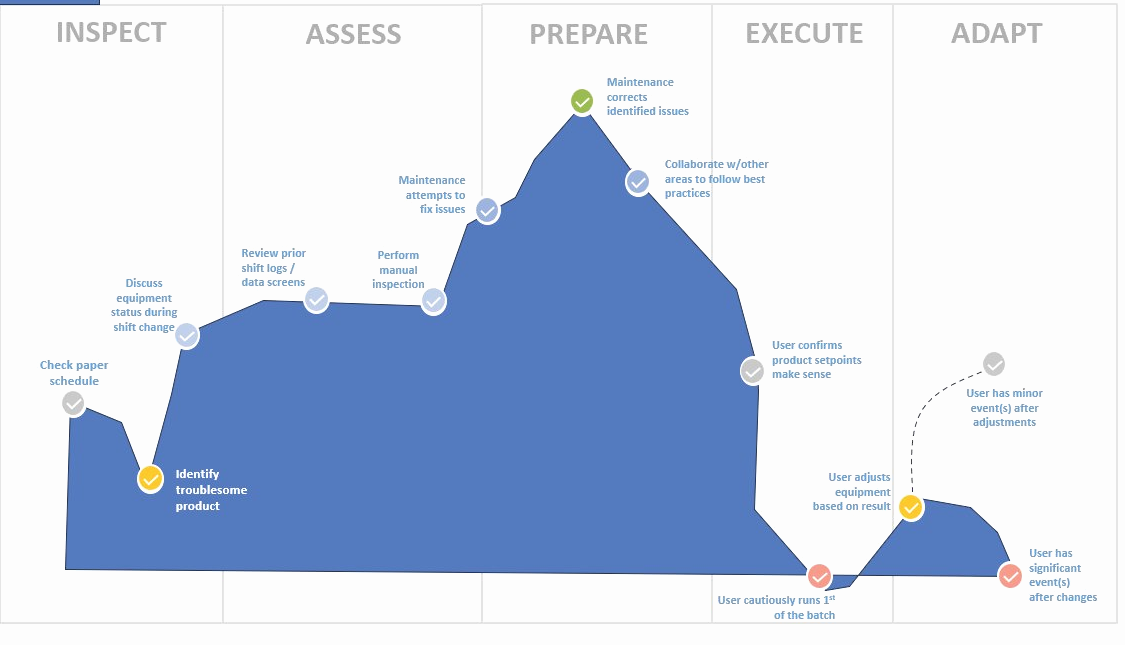
Operator journey map showing Inspect, Assess, Prepare, Execute, Adapt phases with experience quality curve
Artifact preview
Operator journey map
Identifying where operator confidence dropped and intervention support mattered most.
The problem

The issue was not just technical. It was operational.

The organization was operating in a constrained, competitive environment where inconsistent production outcomes affected customer value, cost, quality, and growth.

The existing approach left too much decision-making burden on operators during moments when speed, precision, and confidence mattered most. The opportunity was to design a product and operating approach that could support better decisions in real time — while fitting into the realities of the production floor.

Operating pressure points
!
Capacity-constrained operation
No slack in the system — every production event had direct cost and customer impact.
!
High cost of quality misses
Each avoidable defect represented meaningful financial and throughput loss.
Manual intervention burden
Operators had to make fast, high-stakes calls without a reliable decision aid.
Multiple misaligned stakeholder groups
Operators, engineers, managers, and business leaders had different views of the problem and its solution.
!
Need for safe, trusted adoption
Any solution had to earn trust before operators would rely on it in live production conditions.
How I led

I connected the problem, the people, the product, and the operation.

01

Problem curiosity

I embedded with the business to understand what was truly driving performance gaps, not just what appeared broken on the surface.

02

IQ × EQ leadership

I combined data analysis with stakeholder empathy, listening closely to operators while aligning engineers, managers, and decision-makers.

03

Creative operating design

I translated ambiguous needs into user stories, requirements, product constraints, MVP scope, roadmap sequencing, and launch plans.

04

Follow-through

I stayed with the work through shadow runs, test-group launch, limited production rollout, full launch, and post-go-live KPI monitoring.

Discovery

I started by understanding the people closest to the problem.

Before any product decisions were made, I spent time inside the operation.

Interviewed operators across experience levels
Reviewed operational data and decision patterns
Mapped friction and intervention moments across the journey
Aligned stakeholders on what was real vs. assumed
Key insight
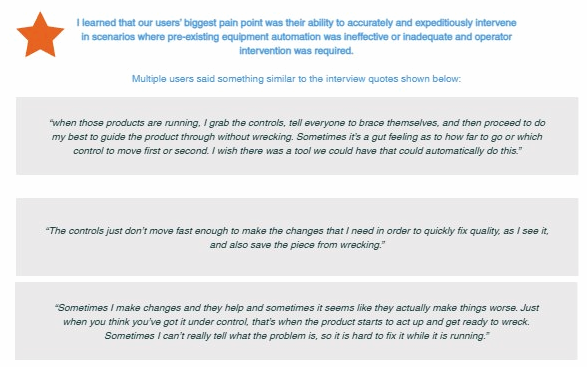
Users didn't need another interface. They needed a faster, more trusted way to act at the right moment — one that reduced hesitation, not just added information.
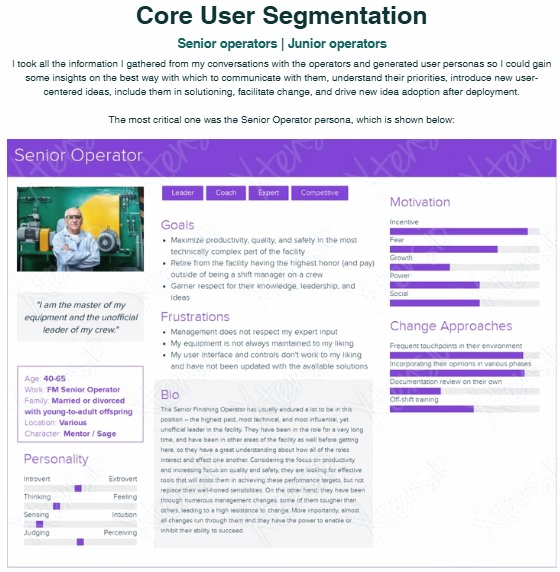
Senior Operator High confidence Process authority Change skeptic Junior Operator Needs decision support High anxiety moments Early adopter potential

User segmentation

Senior and junior operators had different confidence levels, motivations, and support needs.

"When I'm mid-run and something's off, I need to know what to do — and I need to trust it."

Interview insights

Operators described moments where they had to move quickly without a clear or trusted decision aid.

Operator journey map

Journey map

The highest-value opportunity appeared during the transition from assessment to action.

Product definition

I turned user pain into prioritized product decisions.

After discovery, I translated feedback into persona-centered problem statements, solution needs, requirements, and MVP priorities. The work moved from open-ended ideation to a constrained, testable product path that balanced user value, technical feasibility, operational risk, and business impact.

1

Insight

Operators needed faster, more confident intervention during challenging production scenarios.

2

Problem statements

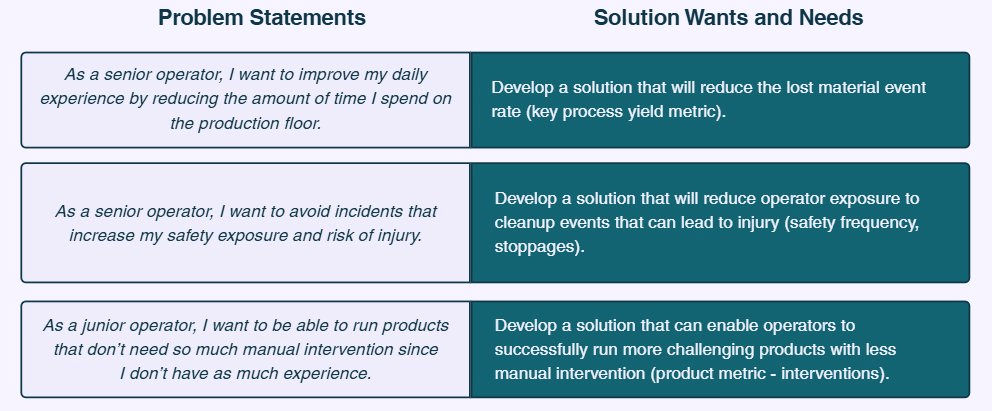
User needs were framed around reducing lost material events, safety exposure, manual burden, and delay rates.

3

Requirements

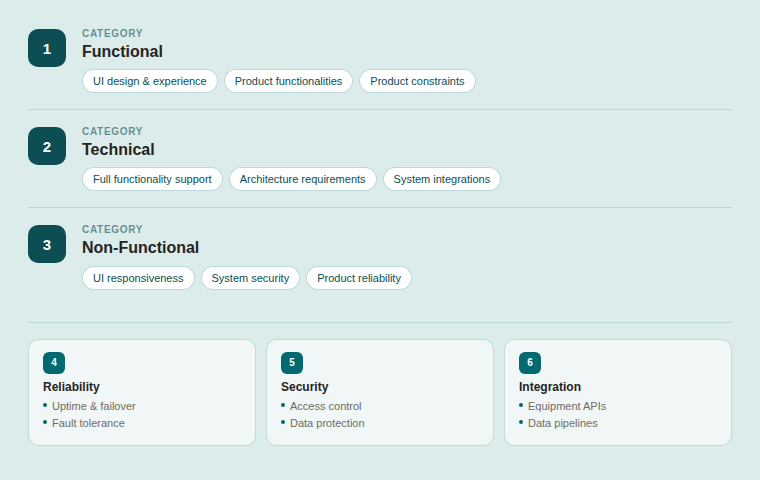
Functional, technical, non-functional, security, reliability, and integration requirements organized into a shared hierarchy.

4

MVP scope

The MVP focused on the highest-value capabilities needed to support safe, trusted, real-time use.

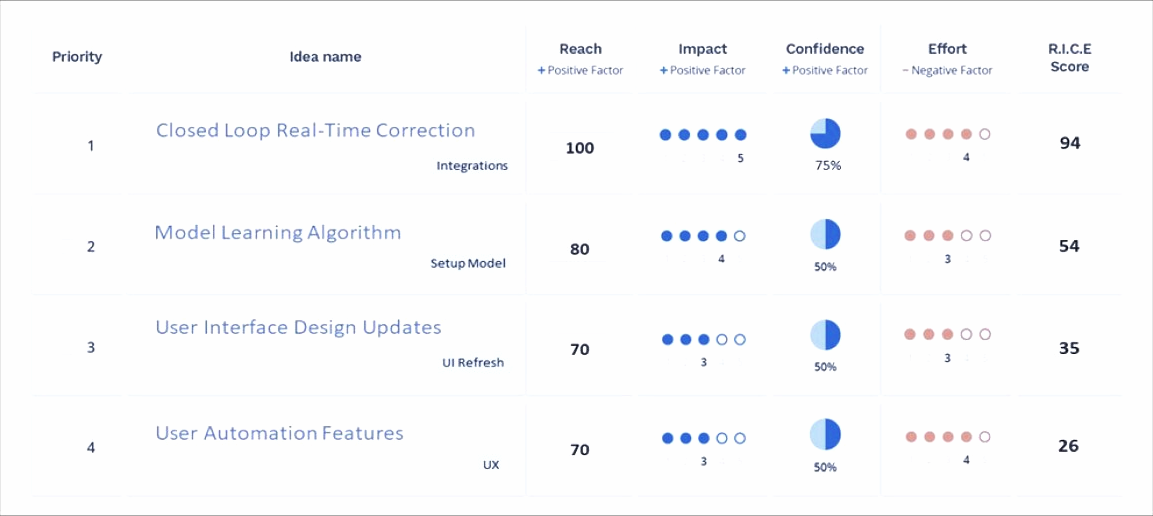
Decision method: I used RICE prioritization to compare reach, impact, confidence, and effort across candidate features — turning intuition into a shared, defensible decision.
RICE prioritization matrix showing four feature candidates scored by reach, impact, confidence, and effort
Decision artifact
Prioritization matrix
Comparing feature candidates by reach, impact, confidence, and effort.
Launch strategy

The product had to earn trust before it could scale.

High-stakes deployment context
This product was deployed into a ~$1B annual production line. Any significant error, unplanned stoppage, or loss of operator confidence during rollout could have triggered cascading production losses and customer impact. The phased launch strategy was not a process formality — it was a deliberate risk management decision designed to protect the operation while building the trust the product needed to succeed.

Because the product would influence real production decisions, launch planning had to be deliberate. I helped sequence rollout in a way that allowed the team to observe product behavior, calibrate functionality, capture user feedback, manage risk, and build confidence before broader deployment.

S
Phase 1
T
Phase 2
L
Phase 3
F
Phase 4
S

Shadow runs

Phase 1

Observed product behavior while keeping the UI operationally disconnected from equipment. Used this stage to validate calculated values, interface behavior, and user readiness.

T

Test-group launch

Phase 2

Released the product to a small group of early adopters, monitored usage, gathered feedback, and addressed functional and non-functional gaps.

L

Limited production launch

Phase 3

Expanded testing across more operators and shifts while monitoring product metrics, production behavior, and stakeholder confidence.

F

Full production launch

Phase 4

Rolled out broadly, continued KPI monitoring, and gathered post-go-live feedback to improve quality, cost, productivity, safety, and yield outcomes.

Adoption was not treated as a communications task. It was designed into the product strategy, rollout plan, and feedback loop.
Artifacts

A few examples of how the work moved from ambiguity to execution.

Senior Operator user persona showing goals, frustrations, personality, and change approaches

User persona

Senior and junior operator personas built from VoC synthesis — informing design, comms, and adoption strategy.

View in case study →
Voice of customer synthesis showing core insight and three direct operator interview quotes

VoC synthesis

Interview themes grouped into a core insight that directly informed RICE scoring and product priorities.

View in case study →
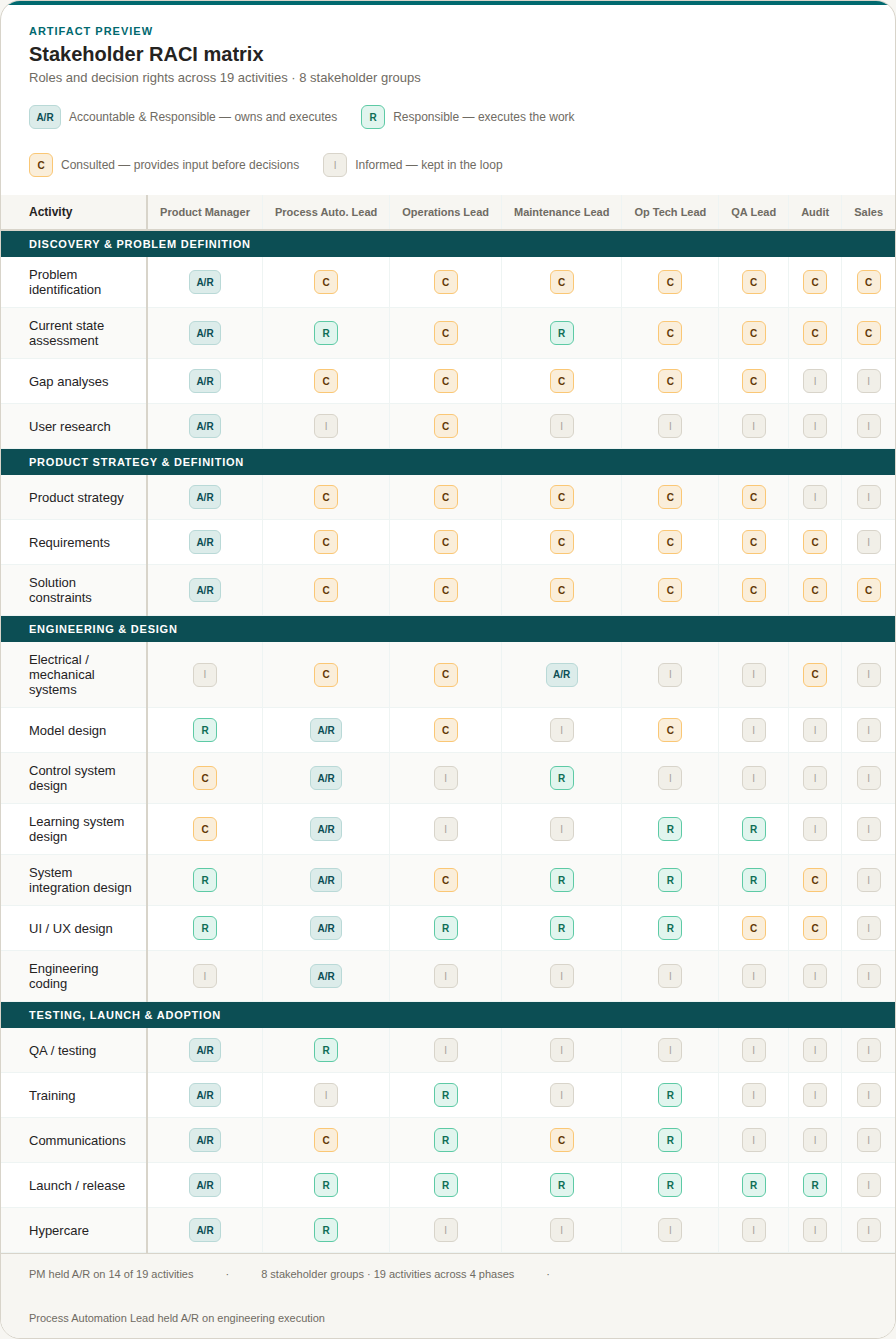
Stakeholder RACI matrix showing 19 activities across 8 stakeholder groups with A/R, R, C, I designations

Stakeholder RACI

Decision rights and accountability mapped across 8 stakeholder groups and 19 activities — PM held A/R on 14 of 19.

View in case study →
Operator journey map across Inspect, Assess, Prepare, Execute, and Adapt phases

User journey map

Translated operator experience into moments of friction, confidence, and intervention opportunity.

View in case study →
Problem statements table showing three persona-centered user needs mapped to solution requirements

Problem statements

Converted VoC research into user-centered value statements that shaped the product requirements.

View in case study →
RICE prioritization matrix comparing four feature candidates by reach, impact, confidence, and effort

Prioritization matrix

RICE scoring used to define MVP scope — grounded in stakeholder priorities surfaced during VoC synthesis.

View in case study →
Product requirements hierarchy showing Functional, Technical, Non-Functional, Reliability, Security, and Integration categories

Requirements hierarchy

Organized functional, technical, non-functional, reliability, security, and integration needs into buildable requirements.

View in case study →
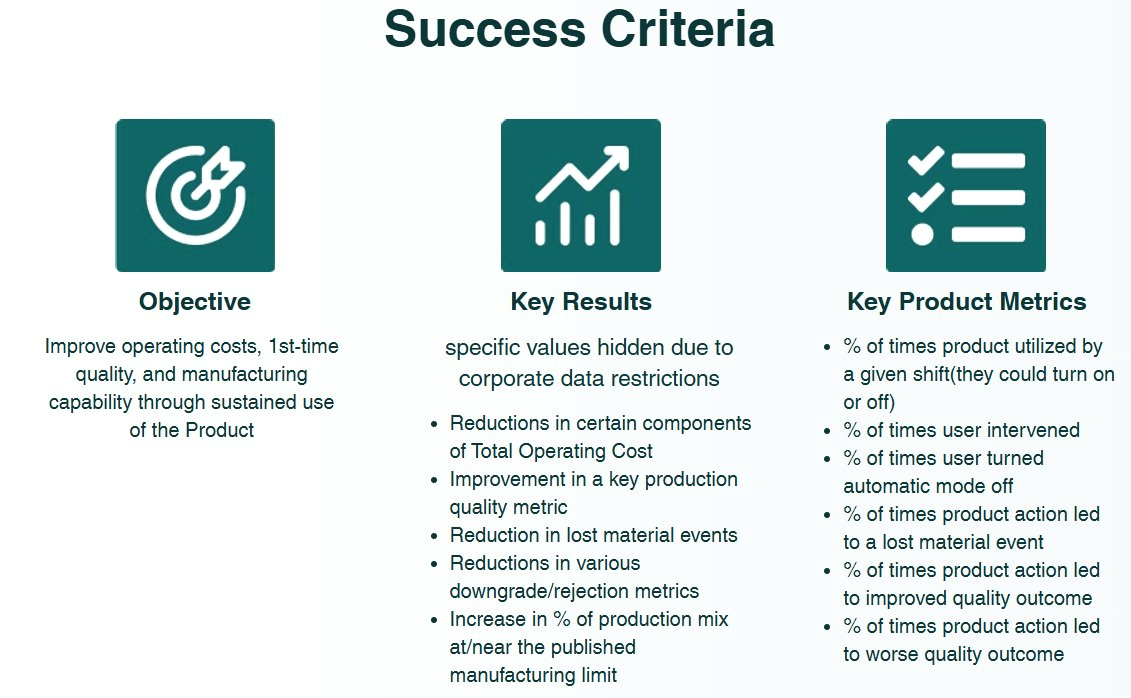
Success criteria showing Objective, Key Results, and Key Product Metrics defined before development began

Success criteria

Objective, key results, and product metrics defined upfront — the pre-agreed contract that governed every Go/No-Go decision.

View in case study →
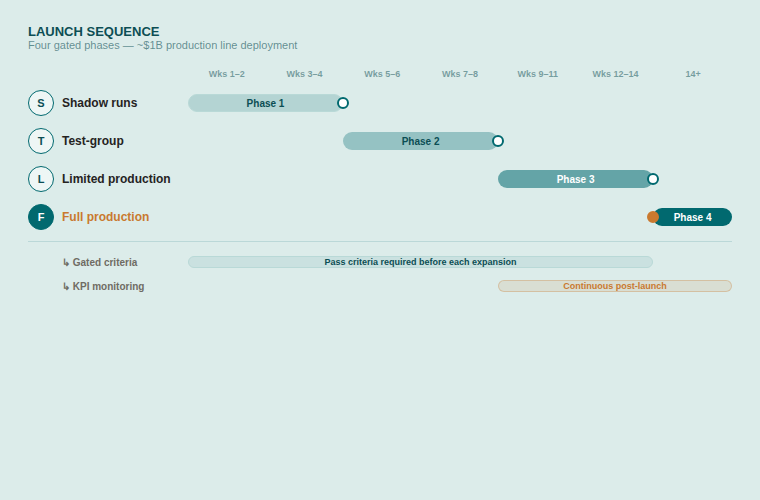
Launch plan showing four phases — Shadow, Test-group, Limited production, Full production — with gate markers

Launch plan

Four gated phases protecting a ~$1B production line — each phase required explicit pass criteria before expansion.

View in case study →
Impact

The product created value across users, operations, and the business.

10%
Increased sales capacity
30%
Improved key department productivity metric
$13M+
Saved through improved operating efficiency
$5M+
Enabled revenue growth through improved yield
~7%
Reduced per-unit department cost vs. baseline

User impact

Operators gained a more trusted way to make decisions during challenging production scenarios, improving confidence and reducing avoidable friction.

Operational impact

The product helped reduce unplanned stoppages, improve consistency, and support higher-quality production outcomes.

Business impact

The effort expanded capacity, supported growth into new customers, and contributed to measurable cost reduction. The product contributed to millions in savings and revenue enablement.

Leadership pattern

I turn complex problems into products people actually use — and stay until the value shows up.

This work reflects the way I approach complex transformation: understand the real problem, listen to the people closest to it, define the product path, manage the tradeoffs, and stay engaged until the operation launches and value shows up.

Start with the real problem

Go beyond symptoms and understand the operating context, incentives, constraints, and user experience before reaching for a solution.

Design for trust and adoption

Build solutions people can understand, believe in, and use under real conditions — across ServiceNow workflows, enterprise platforms, and operational control systems.

Follow through to value

Treat launch, feedback, adoption, and measurement as part of the product, not as afterthoughts that someone else will handle.

Contact

Let's talk about what you're trying to build.

I'm open to product management, operations strategy, and transformation leadership opportunities across healthcare, technology, federal, and enterprise sectors. If you have a hard problem that needs a clear product path, I'd like to hear about it.

Send an email Download resume
Open to opportunities

I'm actively exploring product management, operations strategy, and transformation leadership roles. I'm particularly interested in organizations operating at the intersection of complex systems and meaningful business outcomes.

Roles that are a strong fit
Product Manager / Senior Product Manager
Product Operations Manager
Director of Operations
Digital Transformation Lead
Strategy & Operations Leader
ServiceNow Platform Product Manager
Sectors of interest
Healthcare technology Federal / GovTech Enterprise SaaS Industrial tech Palantir / GovTech Fintech Consumer goods
Ready to talk

Looking for a leader who can turn vision into operational traction?

I bring strategy, product judgment, operational discipline, and stakeholder leadership to complex problems where ideas need to become usable, scalable, value-producing systems.