Everyone is building on top of AI. Chatbots, copilots, agents, wrappers — the application layer is noisy, crowded, and endlessly visible. But beneath that surface sits the real story: a dense, expensive, physically constrained stack of infrastructure that most builders never see and most investors never fully price in. Like an iceberg, what's visible is maybe ten percent of what's actually there.
The critical question for the next decade of AI adoption is not whether the models will get smarter. They will. The question is whether the underlying architecture (the silicon, the memory, the energy systems, the fundamental computational paradigms) can evolve fast enough to stop AI from becoming the exclusive playground of hyperscalers and well-capitalized enterprises.
Right now, that evolution is a race against a clock that is ticking loudly.
The Stack Nobody Talks About
When a developer hits an API endpoint, what actually happens is staggering in its complexity and cost. Somewhere in a data center, a GPU cluster is waking up, pulling billions of model parameters from memory, running them through dense matrix multiplications, managing a growing cache of intermediate attention states — and then doing it again, token by token, sequentially, until a response is complete.
Each of those output tokens costs roughly 2 to 6 times more than an input token, typically around 5, not because of some arbitrary pricing model, but because of physics. Input tokens get processed in a fast, parallel "prefill" phase. Output tokens get generated one at a time in a slow, sequential "decode" phase — and every single step requires reading a growing cache of intermediate attention states from the most expensive memory on earth.
That memory is High Bandwidth Memory (HBM), stacked directly onto AI GPUs. It costs so much that HBM costs rose roughly 35% between 2023 and 2025, even while standard DRAM dropped by half. It is so supply-constrained that HBM3E is sold out 18–24 months ahead, with three manufacturers (Samsung, SK Hynix, and Micron) controlling the entire global supply. HBM now consumes 23–25% of total DRAM wafer capacity, and AI data centers absorb up to 70% of global memory production.
The constraint here is materials and manufacturing, not software.
The Cost Paradox
On the surface, the token cost story looks triumphant. In March 2023, running one million tokens through GPT-4 cost $30. By mid-2026, capability that cost $30 per million tokens at GPT-4's launch now runs as low as $0.10 per million tokens — though at that price it is a budget-tier model, not a frontier one, and commodity tasks can go for $0.05. That is a 300x to 600x price collapse in roughly three years.
And yet: enterprise spending on generative AI reached $37 billion in 2025, 3.2x the $11.5 billion spent in 2024. Inference specifically ran about $23.3 billion, overtaking the $19 billion spent on training. OpenAI spent $8.4 billion on inference alone in 2025 — not training, not research, just running models. Projected 2026 inference spend: $14.1 billion. Roughly a billion dollars a month.
This is Jevons Paradox in real time. Cheaper tokens drive total spend up, not down. And the reason is structural: agentic workflows require 5 to 30 times more tokens per task than a simple chatbot, according to Gartner's March 2026 analysis. Multi-step reasoning chains amplify costs. Always-on monitoring agents consume compute around the clock. Per-token prices are falling, but the unit of useful work (a decision, a completed task, an agent loop) is getting more expensive in real terms.
The floor keeps dropping. The ceiling keeps rising. The gap in the middle is where startups either find margin or die.
Layer 1: The Silicon Wall
The foundation of the entire modern AI stack rests on the GPU, a chip architecture designed in the 1990s for rendering video game graphics. That is not an exaggeration. The parallel matrix multiplication operations that happen to power transformer-based neural networks are the same basic operations that render 3D geometry. Nvidia did not build a chip for AI — AI discovered a chip that had been built for something else.
That chip is now the most important piece of industrial infrastructure on the planet. The Nvidia Blackwell B200 packs 208 billion transistors and delivers up to 20 petaFLOPS of FP4 performance — a 5x leap over the prior H100 generation. The GB200 Superchip provides 30x faster AI inference throughput and consumes so much power it requires liquid cooling. Nvidia controls approximately 80% of the AI accelerator market.
The problem is not capability. The problem is cost, access, and physics. H100s and B200s are priced and allocated in ways that make them structurally inaccessible to most of the world's developers. Building on top of these systems means renting time from the handful of cloud providers who have them, at prices set by their economics, not yours.
Innovations to watch:
Custom ASICs and hyperscaler silicon. Google's TPU v7 Ironwood delivers 4,614 TFLOPS per chip with 7.2 TB/s memory bandwidth, purpose-built for inference. AWS deployed over 500,000 Trainium2 chips for Anthropic's model training — the largest non-Nvidia AI cluster ever built. AMD's MI355X claims 40% more tokens-per-dollar than competing solutions. These custom chips are beginning to crack Nvidia's monopoly on the economics, even if not yet its market share.
Wafer-scale computing. Cerebras Systems took a radical approach: instead of cutting silicon wafers into individual chips, it uses the entire 46,225 mm² wafer as a single processor. The WSE-3 contains 4 trillion transistors, 900,000 AI cores, and 44GB of on-chip SRAM with 21 petabytes per second of memory bandwidth — that is 7,000 times the bandwidth of an H100. By eliminating the HBM memory bottleneck entirely, Cerebras delivered Llama 4 Maverick at 2,500 tokens per second per user — more than double a DGX B200 Blackwell system. For latency-critical applications, this is a different category of machine.
Language Processing Units (LPUs). Groq built chips designed from the ground up for sequential token generation rather than parallel training. Groq LPUs achieve 394–1,000 tokens per second — 3 to 10 times faster than GPU-based alternatives, by eliminating the memory-fetching bottleneck for decode-heavy workloads. They cannot train models, but for inference they represent a fundamentally different cost and latency profile.
Layer 2: The Memory Wall and the Von Neumann Bottleneck
Every classical computer chip, including every GPU, operates on a fundamental 70-year-old design flaw known as the Von Neumann bottleneck: memory and computation are separate, and data must constantly travel between them. In the context of running large AI models, this means billions of parameters must be loaded from off-chip memory on every forward pass. That movement of data, not the computation itself, is the primary constraint on inference speed and the primary driver of energy consumption.
Epoch AI calculated 70 million terabytes per second of cumulative AI chip memory bandwidth as of Q4 2025, growing 4.1x per year. The entire industry is in a bandwidth arms race. The AI hardware race in 2026, as that analysis puts it, "is not about who has the most transistors. It is about who can move data to those transistors fastest."
Innovations to watch:
IBM NorthPole: Eliminating the bottleneck in silicon. IBM's NorthPole chip represents the most concrete published solution to the Von Neumann problem. By co-locating memory and compute across 256 cores, NorthPole eliminates off-chip memory access entirely — all weights are stored on-chip. 2026 benchmarks show 72.7x higher efficiency for LLM inference versus top-tier GPUs. The architecture is now in commercial production for defense and enterprise vision applications, with a 288-accelerator NorthPole inference system published in November 2025. This is not incremental — it is a different computing paradigm in production silicon.
Processing-in-Memory (PIM) and chiplet architectures. Near-memory computing architectures physically place processing units adjacent to or inside memory banks, reducing data transit distance. Academic prototypes like CHIME demonstrate 31–54x speedup and 113–246x energy efficiency over conventional GPU inference on edge model workloads, at under 2 watts.
HBM evolution. The short-term fix is pushing HBM density and speed. HBM4 (16-Hi stacks) is entering production, targeting 2.0 TB/s per stack. But this is evolution within the same bottleneck, not a solution to it.
Layer 3: The Optical Horizon
The most consequential long-horizon breakthrough in AI hardware may be photonic computing — using light instead of electricity to perform calculations. Optical signals travel at the speed of light, generate essentially no heat during computation, and allow massive parallelism through wavelength multiplexing. These properties directly address the two fundamental constraints of electronic computing: speed and energy.
In January 2026, Shanghai Jiao Tong University and Tsinghua University published LightGen in Science — the first all-optical computing chip to run large-scale generative AI models, claiming 100x speed and 100x energy efficiency over leading Nvidia chips. Chinese researchers published 476 papers on optical chips in 2025, more than any other country.
In the U.S., startup Lightmatter unveiled the Passage M1000 in March 2025 — a 3D photonic superchip enabling 114 terabits per second of total optical bandwidth, the highest ever recorded for AI interconnects. Their Passage L200, shipping in 2026, enables over 200 Tbps of I/O bandwidth per chip package — up to 8x faster training time for large AI models. Gates Frontier-backed Neurophos claims its optical processing unit is ten times more powerful than Nvidia's Vera Rubin NVL72 in dense compute workloads at similar power draw. Opticore, with $14.5 million in funding, is developing photonic chips targeting 100x energy efficiency and 25x computational density versus current leading GPUs.
The honest caveat: optical computing is years — possibly a decade — from wholesale replacement of electronic chips in general-purpose AI infrastructure. Its immediate and already-deployed application is interconnects: replacing copper wires with light between chips, eliminating the "Copper Wall" that was threatening to cap data center scaling. As of early 2026, Nvidia's own Quantum-X InfiniBand platform uses TSMC's co-packaged optics technology, supporting up to 144 ports at 800 Gb/s for 115 Tbps total throughput. The optical era is not coming — for interconnects, it is already here.
Layer 4: Neuromorphic Computing — The Brain Architecture
Neuromorphic chips are designed to mimic the architecture of biological neurons: asynchronous, event-driven, and massively distributed. Unlike GPU-style computing, which is synchronous and power-hungry regardless of whether useful work is happening, neuromorphic chips only activate when data arrives — similar to how neurons fire on spikes of relevant signal.
Intel's Hala Point system, the world's largest neuromorphic deployment, packs 1.15 billion neurons into a microwave-sized chassis at 2,600 watts — a fraction of GPU cluster requirements. Intel's Loihi 2 and IBM's NorthPole (which blends neuromorphic and conventional architectures) are now in developer kits. Thermodynamic ASIC architectures from startups like Normal Computing exploit entropy-based computation to slash inference energy per token by as much as 90% compared to GPU-based solutions.
The significant limitation: neuromorphic systems excel at edge inference, vision, audio, and always-on sensing tasks. They remain poorly suited to frontier LLM inference at the scale currently demanded by products like ChatGPT or Claude. The software ecosystem is immature, and training methods for spiking neural networks lag standard backpropagation by years. But at the edge — in devices, cameras, industrial sensors, medical monitors — neuromorphic represents a cost and energy profile that GPUs simply cannot match.
Layer 5: The Energy Crisis Underneath Everything
None of the above matters in isolation from power. AI data centers consumed roughly 35 TWh globally in 2023. By 2026 that number is projected to reach 401 TWh for AI servers alone, with total data center consumption reaching 565 TWh — a 26% increase year-over-year. AI-optimized servers will account for 31% of total data center electricity in 2026, up from roughly 20% in 2025. By 2030, the projection is 44%.
Training GPT-4 consumed electricity equivalent to 150 households for a year. Frontier training runs in 2025 are reaching $300–500 million in compute cost, with projections of $5–10 billion per training run by 2027. Power availability — not chip supply, not capital — is becoming the binding constraint on how much AI infrastructure can be built.
This is not a technology problem in the near term. It is a grid and infrastructure problem. Data centers are already competing for power allocations in major metros. New nuclear, geothermal, and modular reactor projects are being fast-tracked specifically to power AI compute. The economics of the entire stack collapse if power cannot scale with demand.
Layer 6: Algorithmic Efficiency — The Software Answer to Hardware Limits
The most immediately impactful innovations are not in hardware — they are in how models are structured to do less work per useful output.
Mixture of Experts (MoE). Rather than activating all parameters for every token, MoE architectures route each token through only a small subset of specialized "expert" subnetworks. DeepSeek V3 used this to deliver a frontier-class model at $0.14 per million tokens — approximately 1/100th of what GPT-4 cost at launch. MoE can reduce FLOPs per inference by up to 5x versus an equivalent dense model. GPT-4, Llama 4, and most current frontier models are now believed to be MoE architectures. The era of the monolithic dense transformer is effectively over.
Quantization. Running model weights in INT4 or INT8 rather than FP32 reduces memory footprint by 4–8x, dramatically increasing throughput and reducing cost with minimal accuracy loss. FireQ, a new INT4-FP8 co-designed inference kernel, achieves 1.68x faster inference on Llama2-7B over prior state-of-the-art approaches. Combined pruning and quantization frameworks (PQP, GETA, QPruner) reduce model storage to as little as 1/8 of the original while preserving performance. Practical effect: models that required H100s now run adequately on consumer-grade hardware.
State Space Models (SSMs) / Mamba. Transformers have a fundamental inefficiency: attention scales quadratically with context length. A conversation twice as long costs four times as much to process. State space models like Mamba process sequences in linear time with constant memory, making them potentially transformative for long-context applications. They have not yet matched transformer quality at the frontier, but the architectural direction is significant.
Test-Time Compute Scaling. Rather than making a single expensive forward pass, models can generate multiple candidate solutions, verify them, and select the best — using more computation at inference time to achieve results that would otherwise require a much larger model. Research shows that optimal test-time compute allocation can enable a small model to outperform one 14x its size on reasoning benchmarks, at roughly 4x less compute than naive approaches.
Knowledge Distillation. Large, expensive frontier models are used to train small, cheap "student" models that approximate their behavior. This is already mainstream — virtually every sub-$1/million-token model in production is a distillation artifact. The gap between frontier capability and distilled model capability is narrowing with each generation.
What This Means for Startups and Builders
The token price headline is real but misleading. Prices for commodity inference have fallen 300x in three years. The floor for running a capable model is now measurable in fractions of a cent per query. That is genuinely good news for lean builders.
But the structural picture is more complicated:
Corporate behemoths control the physical substrate. Nvidia, Google, Amazon, and Microsoft are not just cloud providers — they are the landlords of the only infrastructure capable of running frontier AI. When those systems are at capacity, there is no alternative. When they change pricing, there is no recourse. Startups that need frontier model access are structurally dependent on entities with entirely different incentive structures.
The real cost is in agentic workflows. A single chatbot query is cheap. An agent that completes a meaningful multi-step task runs 5–30x more tokens. Product economics that penciled out in a demo environment often collapse at production scale, not because of one expensive API call, but because the multiplier on useful work is far higher than anyone models in advance.
The innovators making access democratic are algorithmic, not physical. DeepSeek proved that a well-designed sparse architecture can deliver frontier performance at 1/100th the cost. Quantization is making models that required data center hardware run on a MacBook. These innovations are the near-term lever for democratization — not waiting for optical chips to arrive.
The hardware breakthrough, when it lands, will be sudden. When photonic compute matures for general AI workloads — even partially — the power, cost, and speed curves break in ways that restructure the entire stack. The same is true for in-memory computing architectures at scale. These are not incremental improvements; they are phase transitions. The developers, frameworks, and products positioned to absorb new substrate economics quickly will have significant first-mover advantages.
The Iceberg, Summarized
| Layer | Current Bottleneck | Key Innovation |
|---|---|---|
| Application | Cost of agentic loops at scale | Model routing, caching, tiered intelligence |
| Algorithms | Dense transformer inefficiency | MoE, quantization, SSMs, distillation |
| Silicon | GPU monopoly, power-per-inference | Custom ASICs, wafer-scale (Cerebras), LPUs (Groq) |
| Memory | Von Neumann bottleneck, HBM scarcity | NorthPole on-chip compute, PIM, chiplets |
| Interconnect | Copper bandwidth ceiling | Silicon photonics, Co-Packaged Optics (CPO) |
| Computation Paradigm | Synchronous, wasteful activation | Neuromorphic, thermodynamic ASICs |
| Energy | Power grid saturation | Nuclear, advanced cooling, edge inference |
The application layer is the tip. Everything underneath it is what will determine whether AI compounds as a broadly accessible utility or hardens into an oligopoly of compute-rich incumbents. The innovations happening in silicon, memory, optics, and model architecture are not academic — they are the prerequisite for the AI future that everyone is building toward.
The iceberg is what decides whether that future arrives for everyone, or just for the few who can afford to sit at the top.
Sources: The AI Engineer · Stanford AI Index 2025 · agentmarketcap.ai · Oplexa / Gartner · Cerebras Systems · IBM Research NorthPole · Lightmatter · Introl / AI Accelerators Beyond GPUs · Gartner Data Center Energy · Epoch AI Memory Bandwidth · Nature Optical Computing
Part II: The Breakeven Question — When Can Everyone Afford This?
Where token costs are now, where they have to go, and what the analysts and founders think about getting there.
The price of AI inference has collapsed faster than almost any technology cost in recorded history. That's the easy part of the story to tell. The harder part is mapping the actual economics: at what price point does a startup builder stop doing cost gymnastics and just ship? At what price does an indie developer stop choosing between "use AI" and "stay solvent"? At what price does a consumer device run intelligence the way it runs GPS — always on, never billed?
These are not rhetorical questions. They have real answers, and the industry is converging on them faster than most people realize.
Where Prices Are Right Now
The current pricing stack has a 1,000x spread between the cheapest and most capable:
| Model Tier | Input ($/M tokens) | Output ($/M tokens) | Typical query cost |
|---|---|---|---|
| Commodity (GPT-5 nano, DeepInfra Blackwell NVFP4) | $0.05–$0.07 | $0.05–$0.40 | $0.00003–$0.0001 |
| Budget frontier (DeepSeek V4, Gemini Flash-Lite) | $0.10–$0.30 | $0.28–$0.50 | $0.00005–$0.0002 |
| Mid-range (Claude Haiku 4.5, GPT-5 mini) | $0.25–$1.00 | $2.00–$5.00 | $0.001–$0.003 |
| Premium (Claude Sonnet 4.6, GPT-5.2) | $1.75–$3.00 | $14.00–$15.00 | $0.003–$0.01 |
| Frontier reasoning (Claude Opus 4.6, GPT-5.2 Pro) | $5.00–$21.00 | $25.00–$168.00 | $0.05–$0.25+ |
A typical conversational query on a fast, cheap model — 500 tokens in, 300 out — costs roughly $0.00025 to $0.0004 today. At that rate, serving 1 million user queries costs $250–$400. That is already in the territory of a rounding error for most funded startups.
The problem is that most products are not simple query-response apps. They are RAG pipelines, agentic loops, context-heavy reasoning chains — and those architectures multiply token consumption by 3x to 30x before you've written a single line of product code.
The Breakeven Map: By Builder Type
The Solo Developer / Indie Hacker
The question indie builders face is not cost per token — it's cost per active user per month, measured against what they can plausibly charge.
At current mid-range model pricing (~$1/M tokens), a typical AI app with moderate use per user (around 50 interactions/month at ~1,000 tokens each) costs roughly $0.05 per user per month in inference. That's workable against a $10–20/month subscription. The math holds.
The problem is power users. A user running 500 interactions per month at premium model pricing can cost $5–$15/month to serve — potentially half the monthly revenue before any other infrastructure costs. This is the cost trap that has killed more AI products than bad ideas. The solution is not waiting for prices to fall further — it is tiered usage caps, model routing, and aggressive caching.
The tipping point for an indie developer that eliminates the mental overhead of per-query cost calculation is somewhere in the sub-$0.001 per typical interaction range — which commodity-tier models have already crossed for simple tasks. For reasoning-heavy tasks, that threshold arrives with the next hardware generation.
The Startup (Seed to Series A)
Research from AI.cc across 8,000+ developer accounts identifies $0.10 per million input tokens as the critical threshold — the point at which AI inference stops being a primary constraint on product design and becomes a near-zero marginal cost input, comparable to the role cloud storage pricing plays today.
Why $0.10? The math: a typical enterprise customer support interaction of 500–1,500 tokens costs $0.00005 to $0.00015 per interaction at that rate. A freemium user generating 200 AI interactions per month at 1,000 tokens each consumes 200,000 tokens — costing $0.02 per month to serve. A 3% conversion to a $20/month paid plan generates $0.60 per free user in expected revenue. That is a 30:1 revenue-to-AI-cost ratio — workable freemium economics at scale.
We are already at $0.10 per million tokens for capable models (Qwen 3.5 9B, DeepSeek V4-Flash) as of Q1/Q2 2026. The $0.10 threshold for frontier reasoning capability — the kind needed for complex multi-step workflows — is the next target, likely achievable by 2027.
The Consumer Device / Homegrown App on Personal Hardware
This is the most important frontier, and it has a different answer entirely: on-device inference, where the marginal cost per query is zero.
At 100,000 daily active users with 5 queries per day, cloud AI at $0.003 per query costs $540,000 per year. The on-device development premium is $60,000–$80,000 — a one-time investment. Break-even: 1.6 months. At 1 million DAU, break-even is 5 days.
This is why Apple's on-device models, Meta's mobile inference work, and Qualcomm's AI chipsets for phones are not just engineering curiosities — they are the actual path to zero-marginal-cost AI for consumer devices. The moment a phone can run a capable 7B model locally, the token economics equation for app developers changes entirely. That moment is arriving now for simple tasks and within 2–3 years for the quality bar most consumer apps need.
Where Analysts and Industry Leaders Think Prices Are Going
The Consensus Trajectory
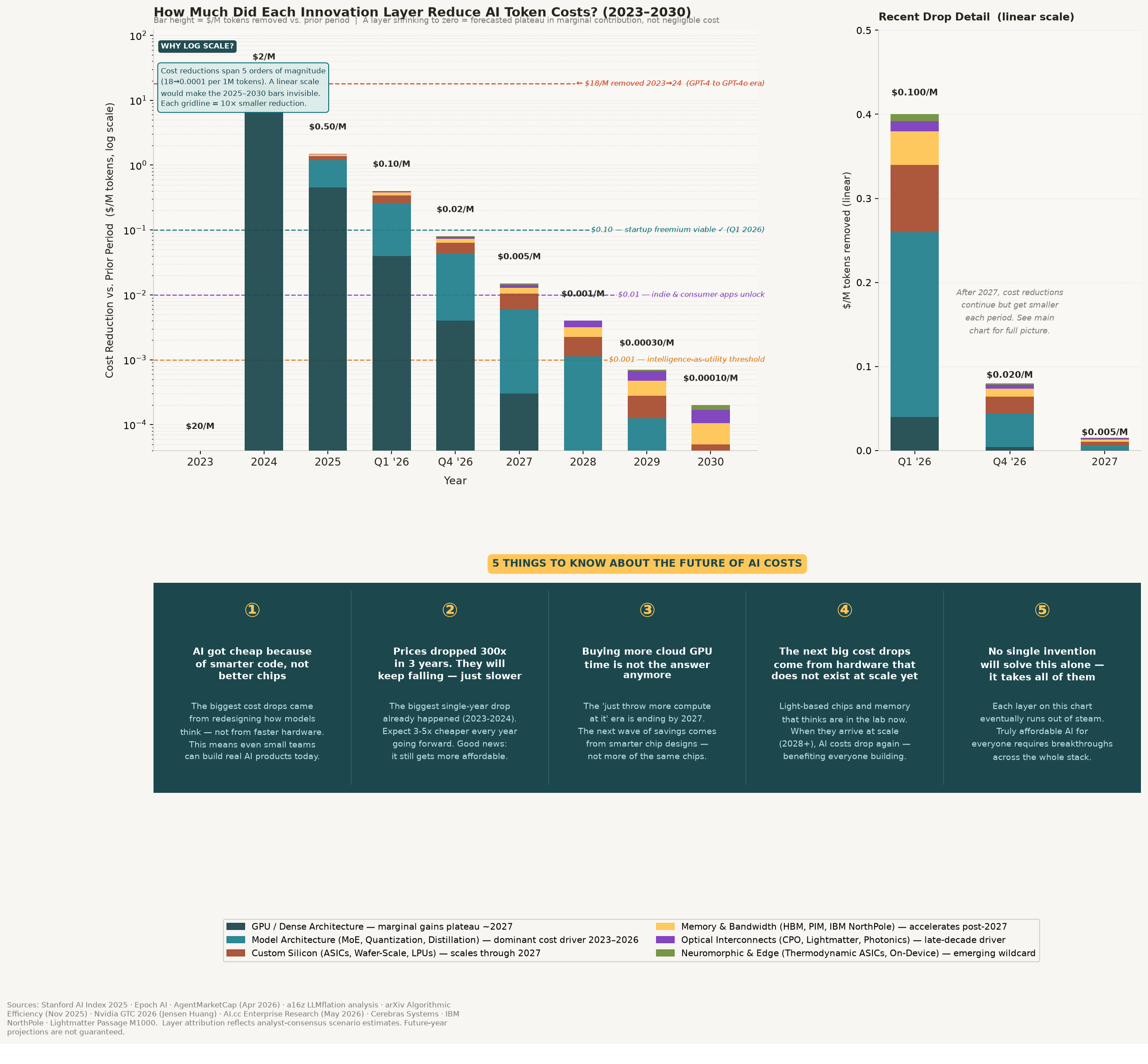
The most cited research on this comes from Epoch AI and a16z's LLMflation analysis:
- 2021–2025: Consistent ~10x annual cost reduction
- 2024–2026: Accelerated to ~200x per year (hardware efficiency + competition + algorithmic improvements)
- 2027: Consensus forecast of 3–5x annual reduction as Blackwell/Vera Rubin gains are absorbed
- Post-2027: 1.5–2x annually as the curve flattens toward physical limits — unless optical computing or neuromorphic architectures change the cost basis
The arXiv paper on algorithmic efficiency from November 2025 finds that hardware alone contributes roughly 30% annual cost reduction; the remaining ~3x per year comes from algorithmic progress. These compound: price-performance on capability benchmarks has fallen 5–10x per year for frontier-level models.
The Specific Milestones the Industry Is Watching
| Price Point | Milestone | Est. Timeline |
|---|---|---|
| $0.10/M commodity | Crossed. Freemium apps viable at consumer scale | Q1 2026 ✓ |
| $0.05/M or below | Already available (DeepInfra Blackwell NVFP4). Always-on log/monitoring agents viable | Q2 2026 ✓ |
| $0.01/M commodity | GPT-4-equivalent capability at near-zero variable cost. Homegrown apps become economically trivial | Q4 2026–2027 |
| $0.50–2/M frontier reasoning | Enterprise-wide agent deployment default | 2027 |
| Sub-$0.01/typical interaction | Intelligence as ambient utility in consumer devices | 2028–2029 |
| Near electricity-cost marginal | Altman's "metered utility" end-state | 2030+ |
AgentMarketCap's consensus forecast: "By Q4 2026, sub-$0.02/M commodity inference becomes available. By 2027, frontier-class reasoning reaches the $0.50–2/M range. By 2028, the economics of 'intelligence as a utility' — comparable to electricity or bandwidth — become real for most enterprise workloads."
Jensen Huang's Forecast
At GTC 2026, Huang stated that Nvidia's Vera Rubin platform (mass production H2 2026) reduces inference token costs by 10x versus Blackwell — which itself was already 4–10x cheaper than Hopper. He has stated on record that token generation costs could fall by ~1,000,000,000x over a decade when stacking hardware, algorithmic, and model architecture improvements. A billion-fold reduction would mean that what costs $0.05 today costs $0.00000005 in 2035 — effectively free at any human-scale usage.
Sam Altman's Framework
Altman has consistently framed the endpoint as intelligence priced like electricity or water — a metered utility where cost converges toward the marginal cost of the electricity used to generate it. His specific framing: "A coding task that once took days of expert work now costs less than a dollar's worth of compute tokens" — and that ratio keeps improving.
The Honest Caveat: Capability Costs Are Rising Alongside Price Drops
Here is the part that the deflationary narrative glosses over. The arXiv algorithmic efficiency paper also finds that "the cost of running frontier-level models has increased approximately exponentially — about 3–18x per year." Bain & Company's June 2026 analysis states: "the pattern so far is that the last generation gets cheaper while frontier stays expensive, and tokens per task scale with complexity."
In other words: yesterday's frontier becomes affordable, but today's frontier keeps getting more expensive as capabilities grow. The gap between "what's possible" and "what's affordable" may not close as fast as headline price curves suggest — especially for startups that need cutting-edge reasoning capability, not last-generation chat.
The practical implication: for most consumer apps and homegrown tools, the economics are already there or arriving within 12–18 months. For the builders who need frontier capability — complex reasoning, long-context analysis, autonomous agents doing substantive work — the cost curve is still a constraint for another 2–3 years at minimum, and the constraint is structural rather than simply a matter of waiting for prices to fall.
The Structural Path to True Democratization
For the truly open AI future — where a developer in Lagos or a high schooler in Wheaton can deploy capable AI in their app the same way they deploy a PostgreSQL database — the price trajectory alone is not sufficient. Three structural shifts need to happen in parallel:
1. On-device inference reaches "good enough" quality. When phones and laptops run 7B–13B parameter models locally with acceptable quality for the majority of use cases, cloud token economics become irrelevant for most applications. Apple Intelligence, Qualcomm's on-device AI, and Meta's mobile inference roadmap are all pointed at this. The timeline is 2–4 years for general-purpose viability.
2. Open-source models close the quality gap. DeepSeek, Llama 4, Qwen, and Mistral are the evidence that the capability gap between proprietary and open-source models is closing. Open-source models captured 38% of enterprise token volume in Q1 2026, up from 11% a year earlier. When an open-weight model can be self-hosted for $2,000–$3,000/month on a single A100 and handles the workload that once required a frontier API at 10–50x that cost, the economic structure of the industry changes.
3. Silicon innovation breaks the current cost floor. At current prices, the limiting factor for commodity inference is still the GPU and HBM memory stack. Photonic interconnects, wafer-scale chips (Cerebras), neuromorphic architectures, and next-gen custom ASICs are all attacking different parts of that cost structure. If any one of these achieves volume production — particularly optical compute — the cost curves break downward in ways current projections don't capture.
The bottom line: the iceberg is melting. The application layer is already accessible to well-resourced builders. The mid-layer — capable AI for indie apps and consumer tools — hits economic viability somewhere between late 2026 and 2028. The deep layer — intelligence as a zero-friction utility embedded in every device and interaction — requires hardware breakthroughs that are being actively built but are 5–8 years from mainstream deployment.
The question is not whether the barriers will fall. They will. The question is whether you build for the infrastructure that exists today, the infrastructure arriving in 18 months, or the infrastructure that arrives when the iceberg is gone.
Additional sources: AI.cc Enterprise Research, May 2026 · AgentMarketCap Token Deflation Curve · arXiv Algorithmic Efficiency Paper · Startups.com Token Economics Lexicon · Wednesday Solutions On-Device vs Cloud Analysis · Tilak Raj AI Cost Breakdown 2026 · Bain & Company Token Economics · Jensen Huang GTC 2026 Keynote · Sam Altman AI as Utility