The first labor risk from AI may not be mass unemployment. It may be the loss of the work that turns beginners into professionals.
For generations, industries built expertise through a familiar sequence. A junior worker did real but bounded work. A more experienced colleague reviewed it, corrected the mistakes, explained the exceptions, and handed over a little more authority each time. The junior worker took home a paycheck and also picked up things that are harder to price: pattern recognition, domain knowledge, professional relationships, and a credible route to economic independence.
That system was often informal, uneven, and sometimes exclusionary. It was also economically essential.
In many fields, though not all and not for every task, AI is starting to produce a usable first pass: the draft, the code, the research summary, the customer reply, the document review. On a spreadsheet that looks like productivity. The harder question is whether firms are removing a productive task without replacing the developmental function it carried.
What happens to an industry when it automates the apprenticeship layer before it has designed a replacement pathway for developing human judgment?
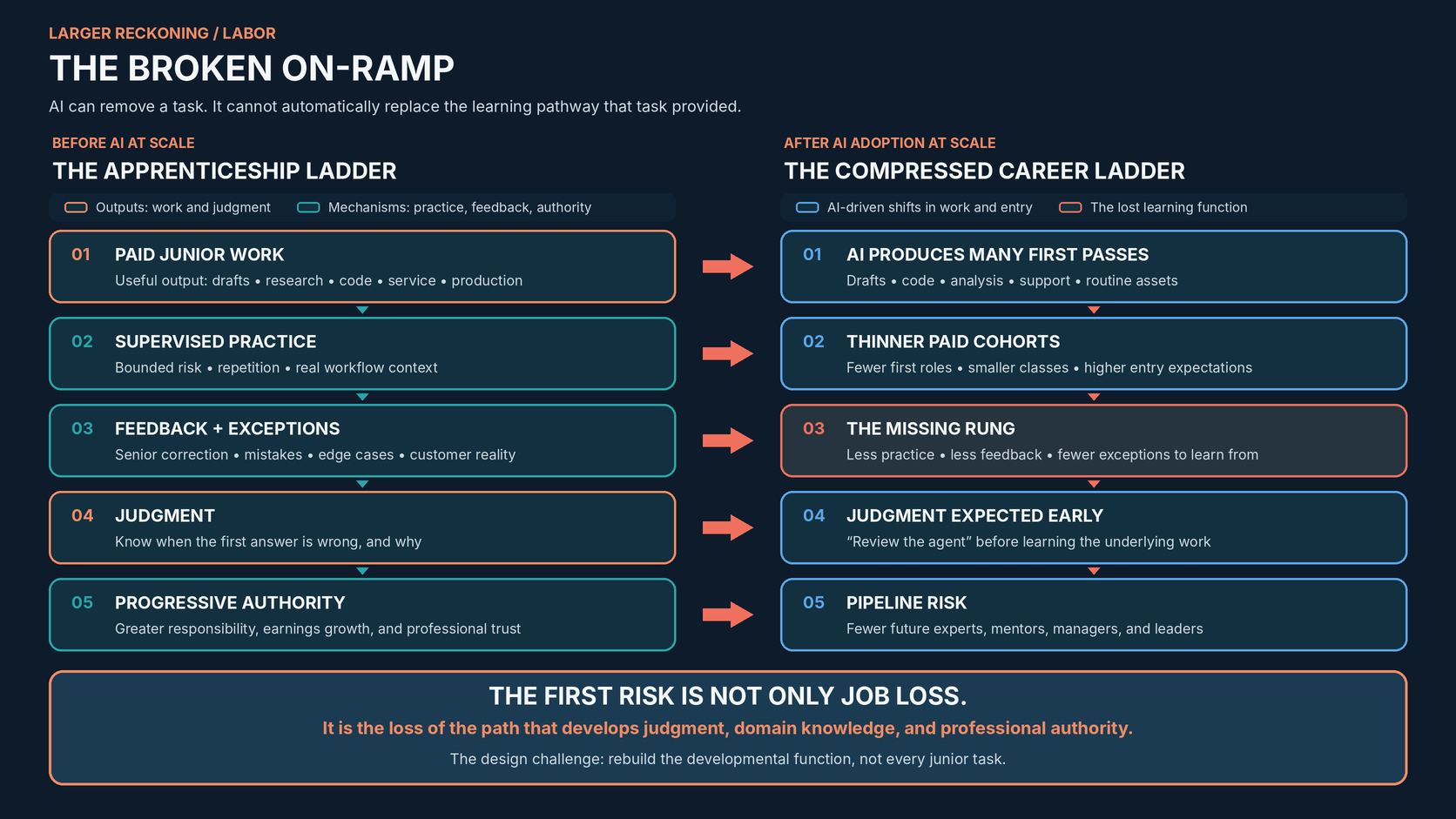
The central risk
An organization saves on junior labor today and underinvests in the capability it will need tomorrow. At first this looks like ordinary efficiency. An AI system drafts the memo or summarizes the case, and the firm can get by with fewer juniors for the same first-pass output.
Junior work was never only output, though. It was hidden infrastructure for professional formation. It taught people to spot weak evidence, handle an exception, recover from a mistake, read a client, find their way around a production system, and distrust a first answer. Take that work away without replacing what it taught, and the firm still needs judgment. It has simply postponed the bill for producing it.
The effect could also reach beyond the firm. If paid entry-level work thins out, fewer young adults would gain the experience, earnings progression, and professional networks that support economic independence. Today's data on young adults living with parents is context for that concern, not evidence of it. Pew found that 18% of U.S. adults aged 25 to 34 lived in a parent's home in 2023, a share that has drifted down since 2017. Realtor.com's June 2026 analysis counted 25.2 million adults under 35 living with parents and reported that roughly 70% of those aged 25 to 34 were employed. That second figure matters because it shows the issue is not only joblessness. Realtor.com attributes the pattern mainly to housing affordability, and debt, wage growth, and household preferences also play a part. AI is not a demonstrated cause. The hypothesis here is narrower: AI could weaken the work-based route through which people have historically built the income and mobility to overcome those pressures.
Sources: Pew Research Center · Realtor.com
One way the chain could run (a hypothesis, not a finding):
The quiet shift in apprenticeship
Formal apprenticeship has historically paired four elements: paid productive work, supervision, progressive responsibility, and recognized competence.
In the United States, registered apprenticeship took root mostly in construction, manufacturing, utilities, and the skilled trades. Wisconsin set up the first state system in 1911, and Congress passed the National Apprenticeship Act, known as the Fitzgerald Act, in 1937. The model paired paid work with related classroom instruction and a recognized occupational credential.
Sources: U.S. Department of Labor · Federal Reserve Bank of Philadelphia
Professional fields built related systems. Law began as an apprenticeship before the law school became the dominant route. Medicine still formalizes the bridge to independent practice: the ACGME calls graduate medical education the critical step between medical school and independent clinical practice, and its requirements extend responsibility to residents in stages, loosening supervision as competence is shown.
Sources: Duke Law Scholarship Repository · ACGME
Across the rest of the modern economy, the form changed while the function stayed:
The job titles varied (analyst, associate, junior developer, paralegal, support representative, production assistant), but the learning logic was similar.
Beginners did useful work. Seniors corrected it. Repetition plus feedback built judgment.
AI now targets many of the first-pass tasks that made this informal system economically viable.
The early signal
The evidence does not show that AI has caused broad, economy-wide displacement. It is consistent with a narrower concern: early-career access may be weakening first in occupations where AI substitutes for routine cognitive work.
Researchers at the Stanford Digital Economy Lab, working from payroll data, find no widespread displacement overall. In the lab's June 2026 update, employment among workers aged 22 to 25 in the most AI-exposed occupations sits about 19% below where it would be had it tracked similarly aged workers in less-exposed occupations. The adjustment shows up more in reduced hiring than in higher separations. Three caveats belong beside that number. The finding is descriptive, not causal. The gap shrinks under some of the researchers' controls, including education-related ones. And the effect concentrates where AI can substitute for codified knowledge more than for tacit, experience-built knowledge. A lot of junior first-pass work is exactly the codified kind, even when what it taught was tacit, which is one reason the apprenticeship layer looks exposed.
Source: Stanford Digital Economy Lab
The World Economic Forum reports that 37% of young workers globally are in occupations with medium-to-high exposure to AI-driven task change. It argues that early careers should be judged by job access, job design, talent pipelines, and how well education systems line up with all three, and not by job counts alone.
Source: World Economic Forum
A missing cohort is quieter than a layoff. It looks like this:
- Fewer internships, assistant roles, and analyst classes.
- Higher experience requirements on jobs still labeled entry-level.
- Smaller teams producing the same first-pass output with AI agents.
- Less supervised practice on real work, and senior review that turns into a bottleneck instead of a teaching moment.
- Young workers asked to "review the AI" before they have learned the underlying work well enough to challenge it.
The seniority paradox
Here is the central contradiction of the AI labor transition:
Employers increasingly want early-career workers to verify, supervise, and improve AI outputs with the judgment of experienced professionals, while automating the work through which people traditionally developed that judgment.
Software engineering shows it clearly. Coding agents can generate first-pass implementations, tests, refactors, documentation, and debugging suggestions. Used well, they make a junior engineer more productive and can speed up learning. Used poorly, they turn the job into a review exercise before the engineer has built the system intuition to catch architectural, security, reliability, or integration failures.
Plenty of engineers still think and code, and many use agents productively. The open question is whether review can stand in for the practical experience that makes review meaningful.
The same structure shows up across sectors. The table below is my synthesis, not a measured dataset.
| Sector | Junior work under pressure | What that work historically taught | Core risk |
|---|---|---|---|
| Software and IT | Coding, testing, debugging, documentation, support | Systems thinking, failure diagnosis, production context | Review expected before system intuition develops |
| Customer operations | Tier-one support, intake, chat and email responses, triage | Customer reality, policy gaps, escalation judgment | Firms lose a human sensing layer and future operations talent |
| Consulting and professional services | Research, models, slides, due diligence, first drafts | Evidence selection, problem framing, client context | The analyst-to-adviser pathway thins |
| Law and compliance | Research, discovery, contract review, drafting, intake | Issue spotting, source discipline, risk judgment | Consequential review delegated before competence exists |
| Finance and accounting | Reconciliation, reporting, KYC/AML, first-pass analysis | Controls, audit trails, materiality, exceptions | Fewer analysts develop control and risk instincts |
| Marketing, media, and design | Drafts, variations, research, production assets | Taste, brand judgment, critique literacy | Portfolio and craft pathways become less paid and less supervised |
| Hollywood and creative production | VFX cleanup, previs, coverage, storyboards, dubbing, background work | Credits, craft fluency, production knowledge, networks | Below-the-line work disappears first |
| Healthcare administration and public services | Intake, claims, summaries, eligibility, correspondence | Procedural judgment, escalation, accountability | Thin oversight can weaken due process and care quality |
Hollywood is not the whole story, but it may be an early warning. My earlier research on AI and Hollywood labor found the same pattern: VFX cleanup, compositing, previs, concept art, storyboards, sound, dubbing, and background work all face high exposure. These are often below-the-line, technical, early-career jobs, and they are where people build credits, craft, and professional networks.
Automation is not one thing
"AI replaces junior work" hides four different changes.
| AI intervention | Meaning | Main risk |
|---|---|---|
| Automation | The task is removed from human work | Fewer entry points |
| Augmentation | A worker completes the task faster with AI | Positive only if learning stays visible |
| Compression | Fewer workers produce the same output | Smaller cohorts and thinner pipelines |
| Abstraction | A junior worker supervises work they never learned to perform | Judgment before experience |
Augmentation can help early careers, and automation or compression may be perfectly appropriate for some work. The danger arrives when abstraction becomes the default and workers approve, escalate, or correct outputs without enough source inspection, domain context, feedback, or exposure to exceptions to exercise real judgment.
Which sectors are most exposed
AI exposure alone is the wrong yardstick. What matters is whether a sector relies on junior productive work to create future expertise, and whether it has a formal replacement pathway.
A useful diagnostic, offered as a conceptual device and not a validated index:
Career-ladder risk = task substitutability × apprenticeship dependence × hiring compression × weakness of the replacement pathway
The ratings below are my qualitative judgment, and the training-model descriptions are simplifications.
| Sector | Training model | Replacement capacity | Career-ladder risk |
|---|---|---|---|
| Skilled trades and manufacturing | Formal registered apprenticeship | Strong: paid work, credentials, progression, supervision | Lower to medium |
| Medicine | Residency, fellowship, supervised licensure | Strong: accreditation, competency gates, progressive authority | Medium |
| Law | Law school plus informal firm training | Limited: licensure exists, but supervised practice is uneven | High |
| Finance, accounting, consulting | Cohort and leverage model | Uneven: strong firms train, no universal pathway | Very high |
| Software and IT | Informal peer review, tickets, debugging, mentorship | Uneven and team-specific | Very high |
| Customer operations | Employer onboarding and coaching | Often weak, high turnover, little credentialing | Very high |
| Creative industries | Guilds, credits, assistants, crews, portfolios | Fragmented; vendor and freelance structures weaken coverage | Very high |
| Marketing and design | Agency review and portfolio pathways | Informal and portfolio-dependent | High |
| Healthcare administration and public services | Process training and supervision | Uneven despite high consequence | High |
The sectors most at risk are not necessarily the most automated. They are the ones where junior work doubled as an apprenticeship that nobody was assigned to replace.
Preserve function, not tasks
Nobody needs to preserve every repetitive task forever. The job is to keep, or deliberately replace, the developmental function each task served.
For every task AI changes, an organization can ask the questions below. The right-hand column works through one example, an AI-generated first-pass contract memo.
| Question | Example |
|---|---|
| What productive output did the junior task create? | A structured initial review and issue list |
| What skill did it build? | Evidence selection, issue spotting, argument structure |
| What feedback did the worker receive? | Senior edits, legal reasoning, client implications |
| What exceptions did it expose? | Ambiguous terms, conflicting facts, unusual risk allocation |
| What future role depended on that learning? | Counsel or manager who reviews consequential advice |
| What now performs the task? | An AI system that drafts and summarizes |
| What replaces the developmental function? | Source inspection, output comparison, annotated feedback, supervised exception handling |
| How is competence verified? | Rubric, observed review, progressive authority, scenario assessment |
A firm that cannot answer the last two has removed a rung without rebuilding it.
From human-in-the-loop to human-in-the-learning-loop
The old human-in-the-loop model was often shallow:
AI does work → human approves at the end
It can be slow, expensive, and developmentally empty. The better model is the human-in-the-learning-loop:
None of this requires a person to click approval on every low-risk agent action. It requires organizations to decide where human judgment matters, how people earn it, when authority expands, and how systems learn from human corrections.
NIST's AI Risk Management Framework offers a compatible governance baseline. Its Map function calls for defined, assessed, and documented human oversight processes, and its Manage function calls for post-deployment monitoring that includes user feedback, overrides, recovery, and change management. NIST AI RMF What the framework leaves out is the developmental half: oversight should also produce more capable humans, and not merely keep an AI system under control.
The Learning Pod
The medium-term organizational response is not a training program set beside ordinary work. It is a deliberately designed operating unit, the Learning Pod.
A pod owns a bounded, real workflow: customer escalation, contract intake, software reliability, claims review, campaign operations, or any process with clear inputs, a quality bar, real stakes, and defined escalation rules. It combines four kinds of participants:
- One senior domain owner, who sets standards and keeps responsibility for consequential decisions.
- One mid-career operator, who turns those standards into reliable daily execution and coaches the workflow.
- Two to four early-career apprentices, who inspect evidence and AI outputs, test results, document their work, handle bounded exceptions, and gradually earn authority.
- AI agents and tools that produce first passes, retrieve information, complete deterministic steps, and flag uncertainty.
The design principle is that the pod produces two outputs:
- Operational output
- completed work at the required quality bar
- Developmental output
- a human worker with more verified judgment than before
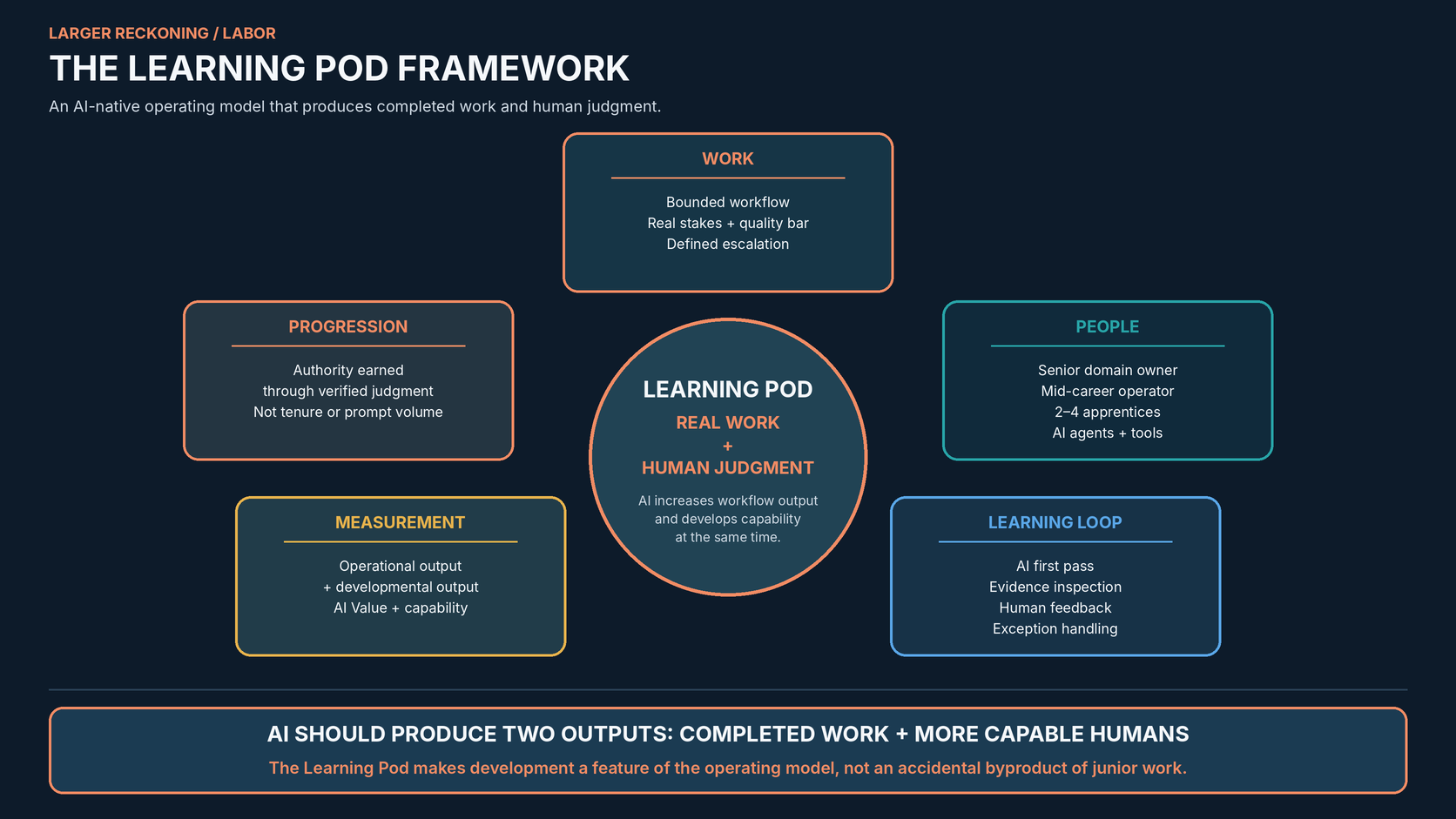
The framework has five design conditions.
1. Work
The pod needs a bounded workflow, and a generic "innovation project" will not do. The work carries real stakes, a clear quality bar, defined inputs, and known escalation conditions. Apprentices cannot build judgment entirely in simulation. They need controlled exposure to real constraints and consequences.
2. People
Roles have to be explicit. The senior is not a final approval button: the senior explains tradeoffs, reviews meaningful exceptions, sponsors expanded authority, and sets the standard. The mid-career operator converts those standards into workflow habits and feedback. Apprentices inspect evidence, test, compare, document, and make bounded decisions. AI agents supply speed and first-pass capacity, never unaccountable authority.
3. Learning Loop
AI first pass, evidence inspection, human feedback, exception handling, verified decision.
The aim is not to keep people busy reviewing agent output. It is deliberate practice: learning where models fail, how evidence conflicts, why an exception matters, and when escalation is appropriate.
4. Measurement
A pod measures operational output and developmental output side by side. Operational measures include completed work, quality, speed, rework, escalation, and AI Value (the value of completed work minus compute, tooling, human review, rework, and failure cost). Developmental measures include time to bounded authority, exception cases reviewed, error-detection quality, mentor capacity, internal promotion, and demonstrated competence.
5. Progression
Authority is earned through verified judgment, and neither tenure nor prompt volume counts as evidence of it.
Built this way, a Learning Pod makes development a feature of the operating model rather than an accidental byproduct of junior work.
The AI Apprenticeship Compact
The Learning Pod is the organizational unit. The AI Apprenticeship Compact is the individual development pathway that runs through and across those units. It moves a person from AI-assisted practice to source and output inspection, then human feedback, exception exposure, progressive authority, and finally verified competence.
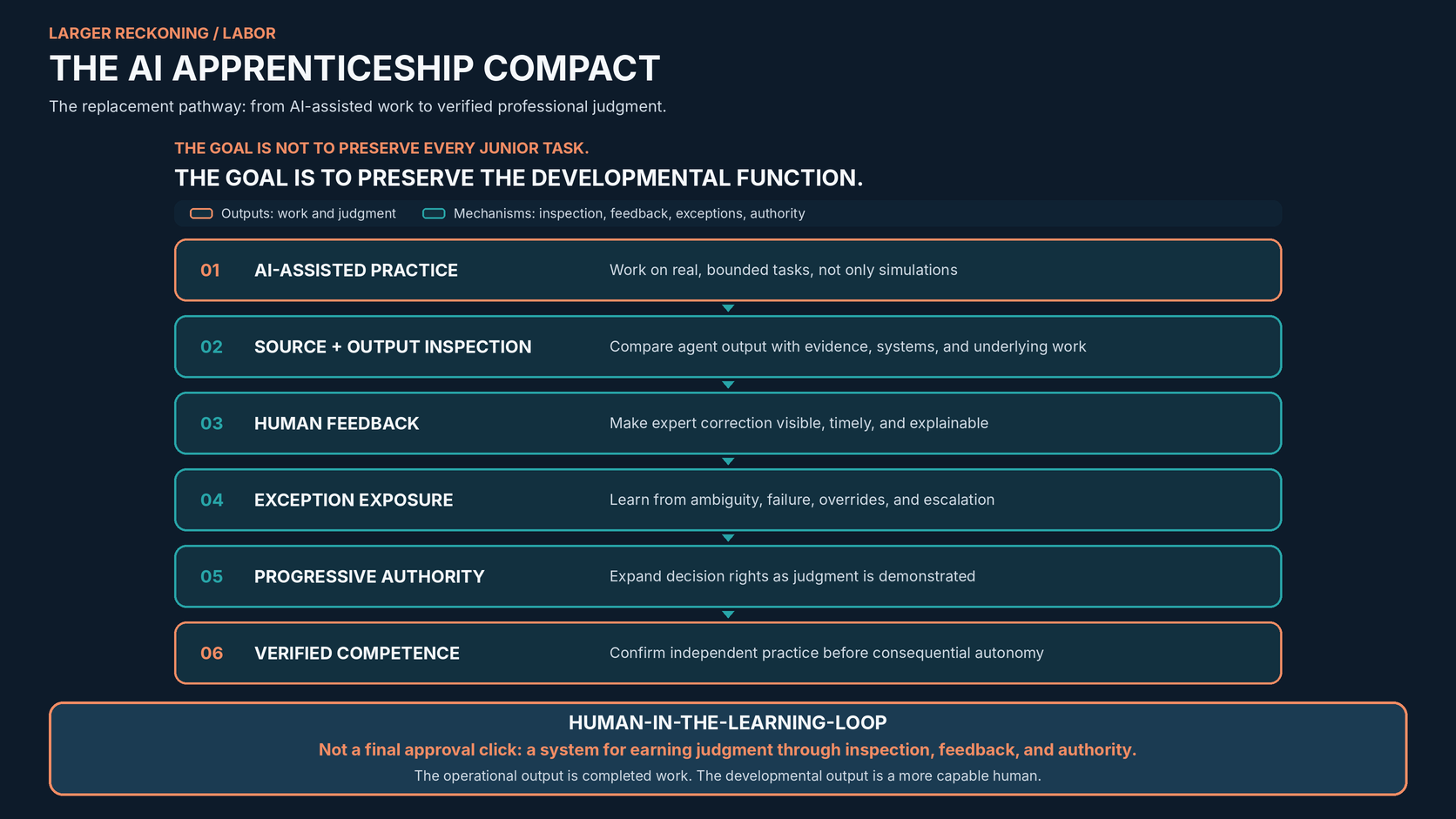
This is no demand to preserve inefficient junior work. It asks organizations to replace the learning function that work served.
What to do next
The response runs on three horizons. The short term keeps the on-ramp open, the medium term builds the replacement pathway, and the long term rebuilds the institutions that produce expertise.
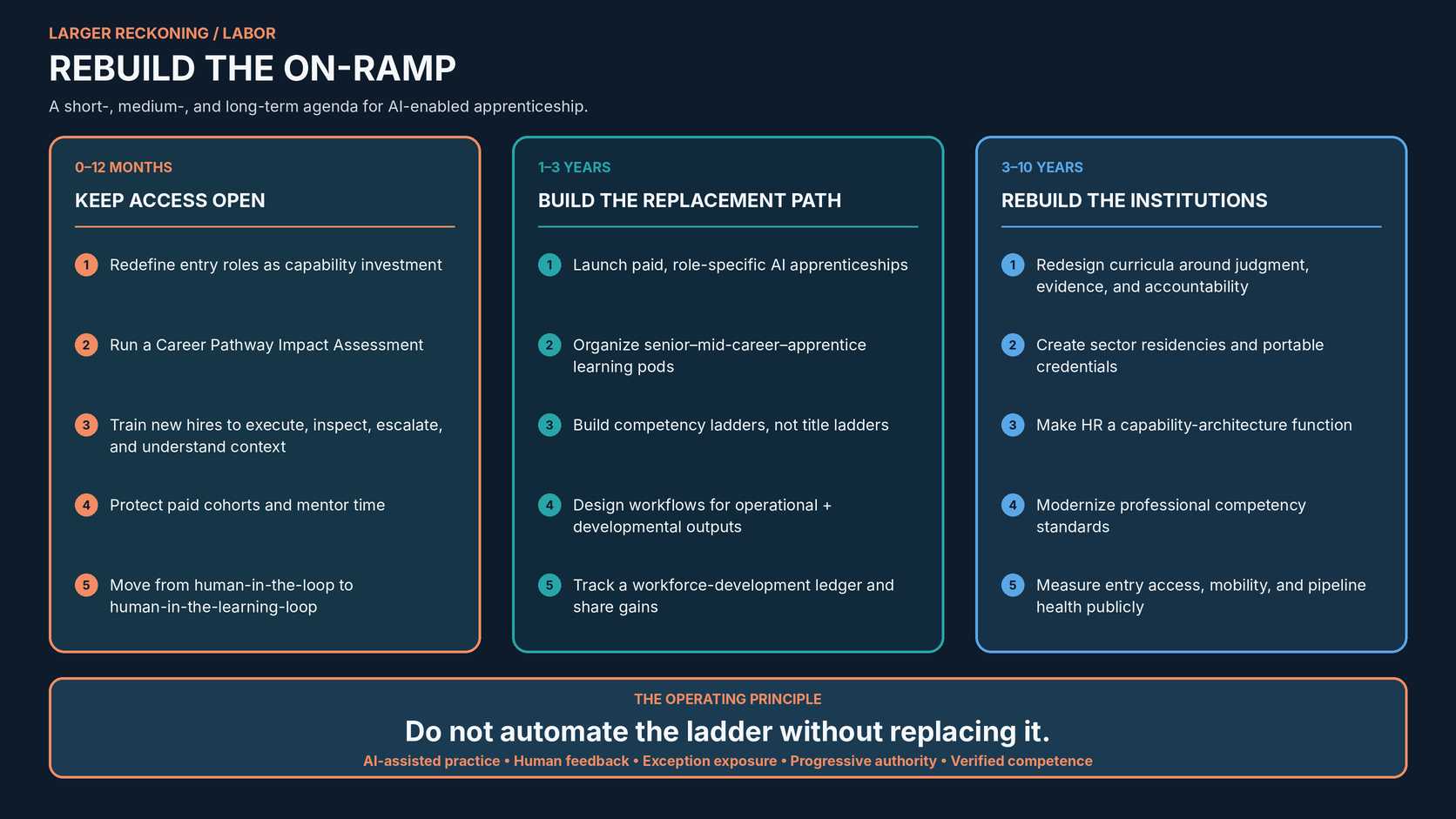
Short term: keep access open
Treat entry-level work as capability investment. Junior employees are more than a source of output. They are the organization's future supply of domain judgment, managers, and mentors.
Run a Career Pathway Impact Assessment before material automation. Identify which junior tasks and paid entry opportunities change, what learning function those tasks supplied, what replaces that function, who owns the replacement, and how the result will be measured.
Train new hires to execute, inspect, escalate, and understand context. AI onboarding that stops at prompt training leaves out the output evaluation, escalation judgment, and workflow knowledge that make a hire useful.
Protect paid cohorts. Do not drop graduate, analyst, apprentice, assistant, intern, or trainee cohorts only because AI shrinks the first-pass workload. If a cohort changes, name the paid pathway that replaces it.
Fund mentor capacity. As AI raises review and exception pressure, mentorship becomes the bottleneck. Protect senior time, reward the quality of feedback, build annotated examples, and run review circles instead of leaning on unstructured manager goodwill.
Medium term: build the replacement path
Create paid, role-specific AI apprenticeships. They should combine real work, bounded authority, AI-assisted practice, exposure to exceptions, named expert feedback, competency milestones, portable evidence of skill, and pay progression.
Organize work in Learning Pods. A senior domain owner, a mid-career operator, two to four apprentices, and AI tools own a bounded workflow, with verified judgment as an explicit output next to completed work.
Build competency ladders instead of title ladders. At every stage, define decision rights, evidence-inspection skills, exception types, escalation rules, quality thresholds, reviewers, and progression criteria.
Keep a workforce-development ledger. Track entry hiring, cohort size, mentor ratio, time to authority, exception cases reviewed, quality of AI-output inspection, internal promotion, reliance on external senior hires, and access outcomes across groups.
Share productivity gains. When automation removes a material share of junior task volume, dedicate a defined portion of the verified savings to paid pathways, mentor capacity, rotations, and competency development.
Long term: rebuild the institutions
Redesign university programs around judgment formation. Students should learn to define problems, inspect sources, critique outputs, recognize error, escalate appropriately, and work with accountable human roles, and a polished first draft should not be the goal.
Create sector-specific residencies, apprenticeships, and portable credentials. Software needs a practical equivalent of supervised residency. Law needs more structured post-qualification practice. Customer operations needs recognized credentials for quality and escalation. Creative sectors need paid, credit-bearing trainee pathways.
Turn HR into capability architecture. The future HR function maps which tasks are automated, which capabilities must survive, what pathways develop them, where authority sits, and whether AI is narrowing access to paid opportunity.
Modernize professional standards. Credentials should validate AI-era judgment: evidence inspection, provenance, exception handling, escalation, decision traceability, and accountable use of AI-supported work.
Measure pathway health publicly. Report entry-level hiring, paid apprenticeship availability, time to first relevant job, wage progression, internal promotion, mentor capacity, age at independent household formation, and access gaps by income, geography, and institution.
The compact as a social contract
The new social contract should be simple:
Organizations that capture value from AI-assisted automation share responsibility for producing the human judgment, professional capability, and broad-based access the economy will need next.
It will take different forms by sector:
| Model | Best use | Mechanism |
|---|---|---|
| Registered apprenticeship | Trades, manufacturing, operations, IT support | Paid work, related instruction, mentorship, credential |
| Residency or supervised practice | Medicine, law, regulated operations, public services | Progressive authority, case review, competency gates |
| Cohort and rotation | Software, consulting, finance, large enterprises | Protected cohorts, rotations, visible expert feedback |
| Guild or collective pathway | Entertainment, media, creative freelance sectors | Staffing minimums, credits, paid trainees, shared funds |
| Studio or portfolio residency | Marketing, design, creative work | Paid projects, critique, portfolio review, client exposure |
| Productivity-sharing fund | Any sector reducing junior task volume | Reinvest a share of verified AI gains in capability development |
The choice
AI can remove repetitive work. It can also make real practice easier to reach, speed up feedback, and put early-career workers in front of harder problems sooner. None of that happens automatically.
An organization that uses AI only to cut junior headcount may create a future shortage of the judgment it needs. One that uses AI to build deliberate practice, visible feedback, exposure to exceptions, progressive authority, and verified competence can open a stronger and more inclusive route into expertise.
The central labor challenge of AI is not simply displacement. It is expertise formation.
An economy that automates junior work without rebuilding apprenticeship may save money today by consuming the human capability it will need tomorrow.
Sources
- Stanford Digital Economy Lab, "Canaries in the Coal Mine?". Treat as an emerging, occupation-specific hiring signal, not proof of broad AI-caused displacement.
- World Economic Forum, Artificial Intelligence and the Future of Entry-Level Work.
- U.S. Department of Labor, apprenticeship history.
- Federal Reserve Bank of Philadelphia, apprenticeships and their potential.
- Duke Law Scholarship Repository, on legal apprenticeship.
- ACGME Common Program Requirements.
- NIST AI RMF Core.
- Pew Research Center, young adults living with parents.
- Realtor.com, employed adults under 35 living with parents.
- Author's earlier research on AI and Hollywood labor.